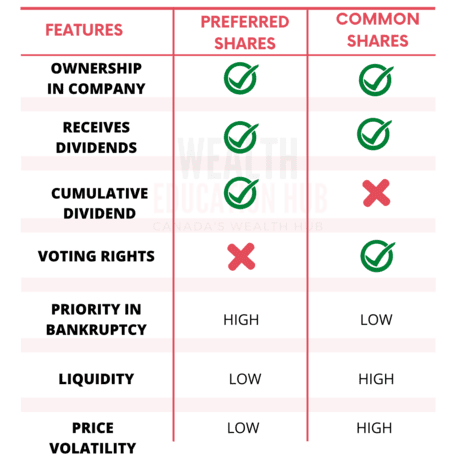
Preferred shares are stock issued by a corporation that represents a claim on the assets. They’re considered a hybrid investment as they have equity and fixed income characteristics. In terms of equity characteristics, preferred stocks trade on an exchange and have no fixed maturity. They’re noted down on the equity side of a company’s balance sheet. Fixed income characteristics include the fact that preferred holdings pay fixed dividends, have a par value and carry no voting rights. Holders of preferred stock are prioritized over those holding common stock..
Features of Preferred Shares
Dividends
Preferred stocks pay a dividend, stated as a percentage of the $25 par value. The dividend rate on the shares are set when the shares are first issued. The dividend rate can be based on a fixed rate, reference rate or floating rate. In terms of a reference rate, 5 Year Government of Canada Bond or 3-Month Government of Canada Treasury Bill Rate may be used. Floating rate may cause the dividend amount to vary as as it moves in line with current market conditions. The dividend that you would receive from preferreds would depend on the type of share you’re holding, discussed below.
Perpetual & Callable
One interesting feature of preferred equity/shares is that they don’t have a maturity date as bonds do. However, they be re-called at set intervals or prices by the issuer. Usually, every 5 years, the issuer may recall the shares or issue a new preferred share. Preferreds are often recalled when a company can refinance the shares at a lower dividend rate.
Capital Structure
On the hierarchy of a company’s capital structure, preferred stock is higher than common stock but behind bondholders in a claim for distributions. In event of bankruptcy, the bondholders will have first claim on assets, followed by preferred shareholders, then common equity shareholders. Before common shareholders are paid a dividend, preferred shareholders must be paid first. As well, keep in mind that dividends on preferred equity is cumulative. If a dividend is not paid in one quarter, it gets added to the second quarters dividend.

Types of Preferred Shares
There are various types of preferred stock, each structured differently. Below are the most common preferred stock that you might run into during your course of investing.

Rate Resets Preferred Shares
Rate Resets Preferred Shares are one of the most popular shares in the Canadian preferred shares market. Over 50% of preferreds are rate resets. These pay a fixed dividend rate until their reset date. The reset date is typically every 5 years.
When the reset date comes around, the issuer has the option to call the shares. If the shares are not called back by the issuer, a new a dividend rate will be locked in.
This fixed rate is usually based on the 5 year Government of Canada rates plus a premium. If an investor is not comfortable with a fixed rate, they can opt for a floating rate coupon.
These type of preferreds are popular as the investor has a predictable source of income.
Floating Rate Preferred Shares
Floating rate preferred shares pay a dividend where the rate is tied to a reference rate, usually Bank of Canada’s prime rate or Government of Canada’s 90 Day bond yield. The dividend payment would be adjusted at each payment date based on the reference rate. These type of preferred shares have a minimum dividend rate that investors might find attractive.
Perpetual Preferred Shares
Perpetual preferred shares pay a fixed dividend for as long as they’re in issuance. These type of shares have no maturity date but have a call date. The issuer can redeem or “call” these shares on or after the call date. When it comes to their duration, they’re similar to corporate bonds which is roughly 25+ years. However, the duration for banks are medium term in nature, 10 years.
Cumulative Preferred Shares
These types of preferred shares have a fixed cumulative dividend feature and paid out if or when declared by the Board of Directors. If no dividend is paid out in the quarter, the dividends accrue or accumulate to be paid in the next quarter.
Retractable Preferred Shares
Retractable preferred shares pay a fixed dividend. These type of preferred shares force the issuer to redeem the shares at par value on a specific date, if the holders opts to. There are two types of retractable shares. One forces the issuer to redeem the shares for cash and the other forces the issuer to redeem the shares in common shares.
Convertible Preferred Shares
Convertible preferred shares give the shareholder the option of converting it to common stock after a set date or on a specific date. These type of preferred shares are attractive to investors because the security that the fixed income dividend provides and the opportunity to gain from a rise in the share price.
Advantages of Preferred Equity
- Preferential Capital Structure – Preferred equity ranks higher than common stock on a company’s balance sheet. Dividends on preferred stock has to be paid before common stockholders. This structure gives preferred shareholders a peace of mind.
- Known Dividend Rate – Unlike common stock that could experience a dividend cut, the dividends on preferred stock are determined when they’re issued. Certain preferred stocks have cumulative features where any missed dividends accrue and must be paid on the next dividend date. A holder of a preferred share must receive their dividends before common shareholders.
- Tax Efficiency – Dividends from preferred stock have preferential tax treatment when compared to bonds. Bond interest is taxed at an investor’s full marginal tax rate but income from Canadian preferred stock is treated more favorably during tax time, thanks to the Dividend Tax Credit.
- Low Volatility – In normal market conditions, preferred stocks tend to be less volatile than common stock but do have a higher volatility than bonds. An investor might find that preferred equities provide a more attractive risk/return profile compared to other fixed income securities.
Preferred Equity vs Common Equity